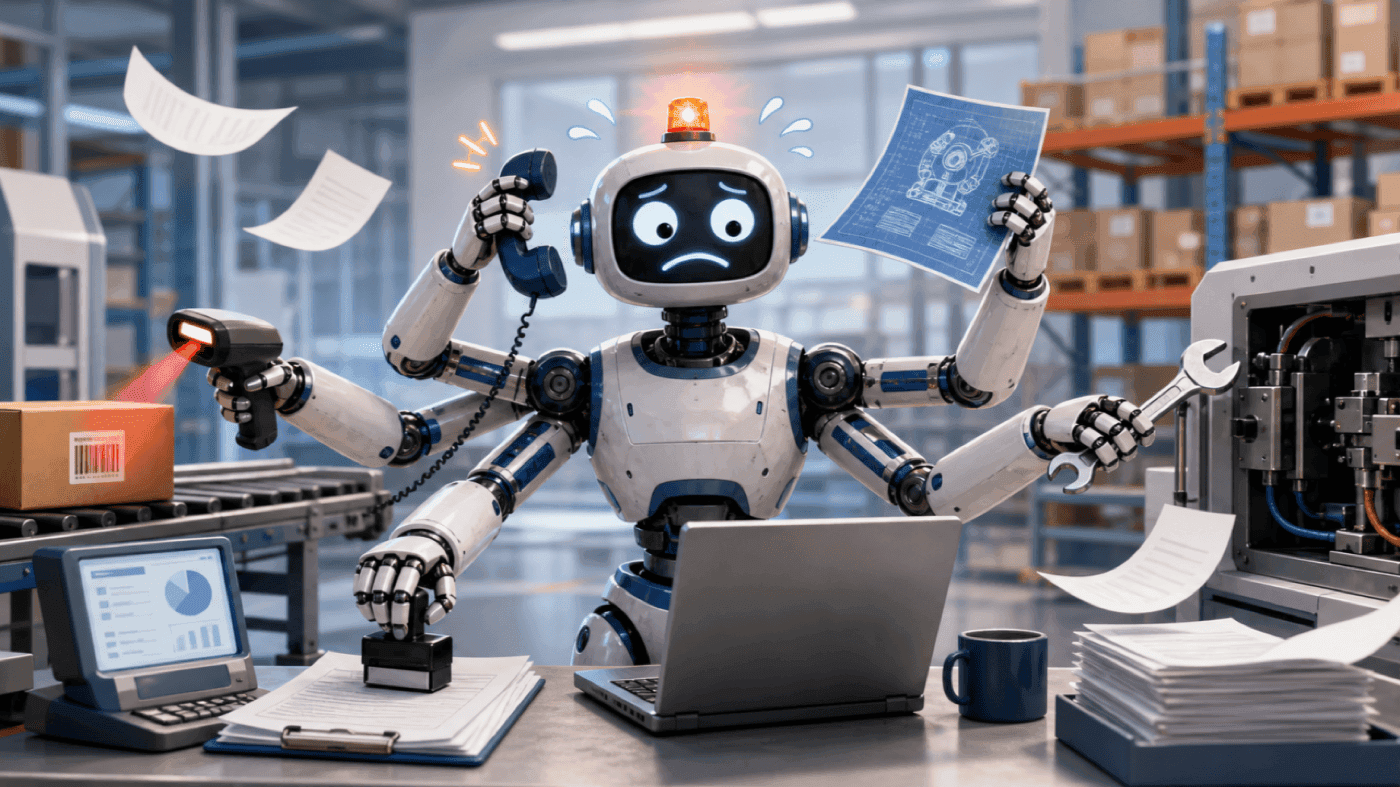
There is a lot of talk right now about building AI agents that can do everything.
They can answer customer questions, configure products, check inventory, prepare quotes, troubleshoot equipment, update the CRM, and even make you coffee (as I experienced first hand recently at Automate 2026).
It sounds impressive.
It also sounds like a job description no reasonable company would give to one person.
Industrial businesses rely on specialists for a reason. Products are complicated. Pricing has rules. Inventory changes constantly. Engineering decisions have consequences. Service requires knowledge of the equipment, its history, and the customer’s application.
Why would AI be any different?
The Future Belongs to Specialists
I believe the future of industrial AI will not be one general-purpose agent trying to know everything.
It will be a group of specialized agents working together.
A product agent that understands specifications, compatibility, and applications
A pricing agent that understands contracts, discounts, approvals, and margin rules
An inventory agent that understands availability, lead times, and substitutions
A quoting agent that assembles an accurate commercial response
A service agent that understands installed equipment and maintenance history
An ERP agent that completes the appropriate transaction
The customer asks one question. The right specialists work together behind the scenes to provide an answer and move the work forward.
That is starting to become possible because AI agents are learning how to communicate with one another.
Why A2A Matters
Axios recently reported that Google’s Agent2Agent Protocol, known as A2A, is moving into the Agentic AI Foundation. The goal is to establish an open standard that allows AI agents from different vendors and platforms to work together.
The technical details are important to developers. For industrial leaders, the business implication is much simpler.
You may not have to choose one AI platform to do everything.
A product agent from one provider could work with an inventory agent from another. Those agents could communicate with a quoting agent, an ERP agent, and a customer-facing agent without requiring a completely custom connection every time.
The official A2A documentation describes exactly this kind of collaboration. Agents can discover one another’s capabilities, delegate work, exchange information, and coordinate longer-running tasks.
Google has also made the case that the "one big agent" approach may work for a demonstration but becomes difficult to manage in production. Its alternative is a coordinated group of agents with narrower responsibilities.
That feels much closer to how industrial companies actually operate.
Standards Do Not Create Expertise
Here is the important distinction.
A standard can help agents communicate. It cannot give them industrial expertise.
Knowing how to send a request from one agent to another is not the same as knowing:
Which motor fits a specific application
Whether two components are compatible
Which configuration can actually be manufactured
Whether an alternative product meets the requirement
Which customer-specific price and approval rules apply
When engineering needs to review the answer
That knowledge comes from product data, engineering documents, enterprise systems, business rules, customer history, and experienced people.
Standards make the handoff possible.
Specialized knowledge makes the handoff valuable.
Think About the Shipping Container
The shipping container did not make every product inside it the same.
It created a standard way for ships, trucks, ports, and railroads to move very different products through one connected system.
A2A could play a similar role for AI agents.
The standard is the container. The specialized agent is what is inside.
Industrial companies will still need agents that understand their products, customers, workflows, and industry. The difference is that those agents may be able to work with other specialists without every interaction becoming another expensive integration project.
What This Means for ReshapeX
This aligns closely with how we think about ReshapeX.
Industrial companies do not need another general-purpose chatbot sitting outside the business. They need specialized intelligence grounded in product knowledge and connected to the systems and workflows where sales and service actually happen.
ReshapeX can serve as the intelligent engagement layer that understands the customer’s request, brings together the right information and specialized capabilities, and helps move the interaction toward an answer, a quote, an order, or a resolution.
It does not need to replace every system or become the only agent in the enterprise.
It needs to make complexity feel simple to the customer.
Do Not Hire One AI to Do Every Job
Over the next few years, companies will be offered plenty of AI platforms claiming to do everything.
We have seen this movie before.
The better question is not whether one agent can perform an impressive list of tasks in a demonstration. It is whether a group of trusted specialists can work together inside the real business, with the right knowledge, permissions, ownership, and human judgment.
Industrial companies were not built around one employee who knows everything.
Their AI strategy should not be either.