Vishal Misra, a computer science professor at Columbia, published a piece a few days ago called The Verifier Bottleneck. It argues that recursive self-improvement is limited by verification rather than compute. It also gave me a cleaner way to explain something I have been fumbling in customer conversations for a year.
His setup is a conceptual object he and Siddhartha Dalal introduced in a 2024 paper, The Matrix: every possible prompt as a row, every possible next-token distribution as a column. No model stores it. A model stores a compressed approximation that reconstructs the small region natural language actually occupies. Chain of thought then unfolds computations already latent in there, which is how a model produces a result nobody memorized. What it cannot do is add information that was never in the system. His phrasing: "Compute buys proposals; verifiers buy knowledge."
Then he asks where the verifier lives.
In mathematics, verification is nearly free. A proof checker is another computation. Propose, check, discard, repeat, and the whole loop closes inside silicon at the cost of tokens. Frontier math fell first because both halves of that loop live in the same place.
The same shape explains software. A coding agent cannot lie to the compiler. The build runs or it does not, tests pass or they fail, and the agent reads the failure and corrects before a person sees any of it. Verification is free, instant, and sitting inside the work, which is why coding agents got good while other domains stalled.
Science moves the verifier outside computation. A drug has to survive a trial, a material has to be synthesized, an aircraft has to fly. Misra uses AlphaFold: it collapsed one expensive search and did not solve biology, because researchers still have to decide which structures matter and which experiments are worth running. Every genuinely new bit comes from an experiment, not from reprocessing the model’s own predictions.
Industrial commerce is a third case, and what makes it harder than science is the verifier itself. Nature is authoritative. Consulting it is slow and expensive, but it holds no opinions and does not misremember. Run the trial and the answer is the answer.
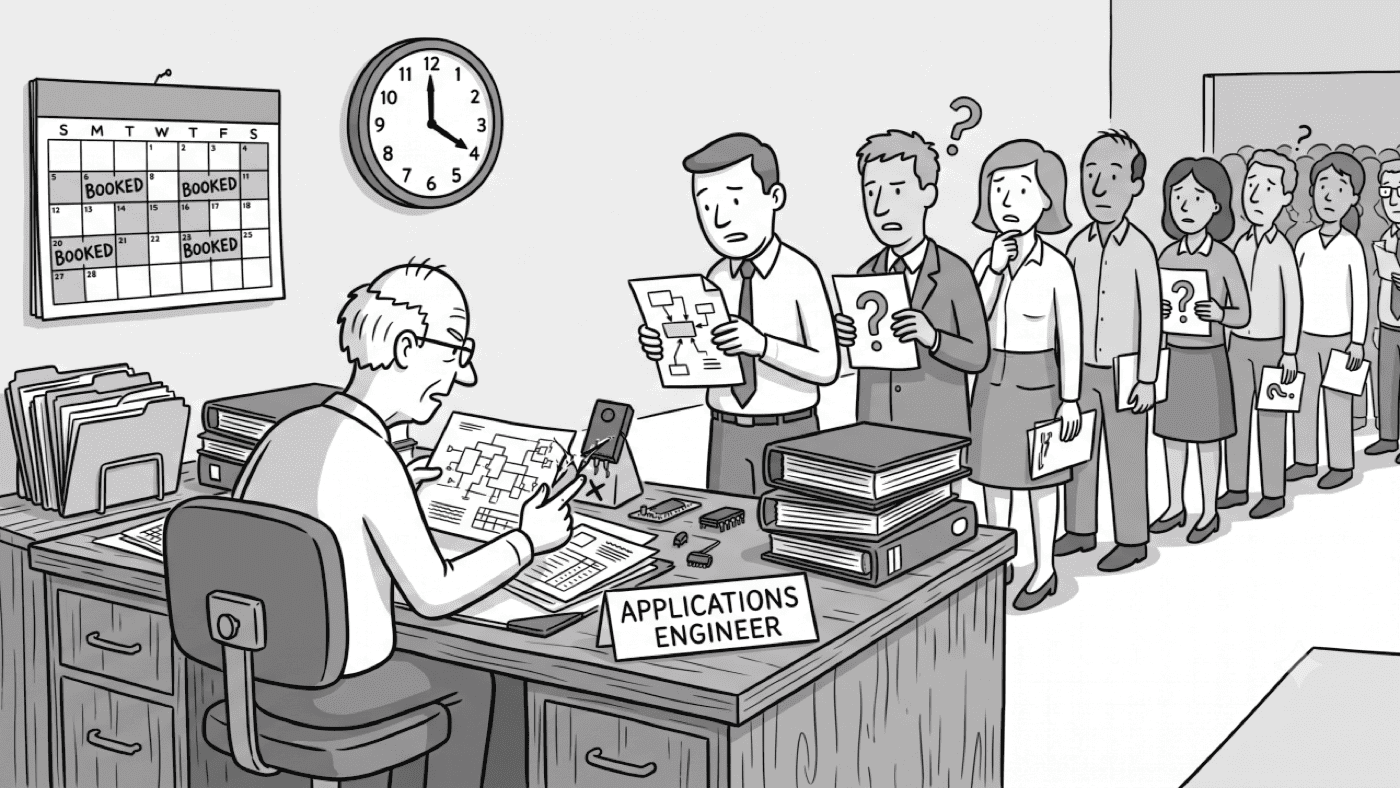
Here the verifier is an applications engineer. The person who has spent fifteen years with a product line and knows the exception that appears in no datasheet. When they confirm a crossover holds and explain why, real information enters the system, and nothing else in the loop produces any.
That person is also the most expensive input in the building. They are senior, they are booked, and every hour spent confirming what an agent got wrong is an hour not spent on a customer project. They can also be wrong. Two experienced engineers can disagree about the same substitution and both have defensible reasons, and there is no proof checker to settle it. Sometimes the honest answer is that it depends on conditions nobody wrote down.
So access to verifiers is only half the problem. The other half is what you do when they conflict, and whether you can trace a stored answer back to who established it and on what basis.
Follow that through and verifier capacity becomes the scarce input in industrial AI. Everyone has the same models, and they will keep getting better at proposing. What almost nobody has is structured access to people who can adjudicate whether an answer is correct, plus the discipline to capture what they say while they say it.
That is what a forward-deployed engineer does. The job is buying verifier bits in a domain where the verifier does not scale and is retiring.
Misra ends on efficiency. The limit is not how fast models think but how well each verifier bit becomes the next shortcut. In mathematics the search-to-path ratio keeps falling because checking costs almost nothing. In science every wrong path is purchased from nature, so shortcuts matter more.
In industrial commerce every bit is purchased from an expert’s time, the most constrained input in the business. So the artifact that stores those bits is the asset. Which suggests a new metric to track. Not model benchmarks or answer volume, but how many expert hours per month you convert into stored, reusable knowledge, and how much of that you never have to buy again.
This is what we build at ReshapeX. The knowledge graph is where the verifier bits accumulate: product families, compatibility rules, replacement chains, each one traceable back to the source it came from and the engineer who approved it. Our forward-deployed engineers sit with a customer’s applications people and encode what they know, brand by brand. Once a rule is captured and validated, it stays captured. Nobody spends an engineer’s afternoon establishing it a second time.