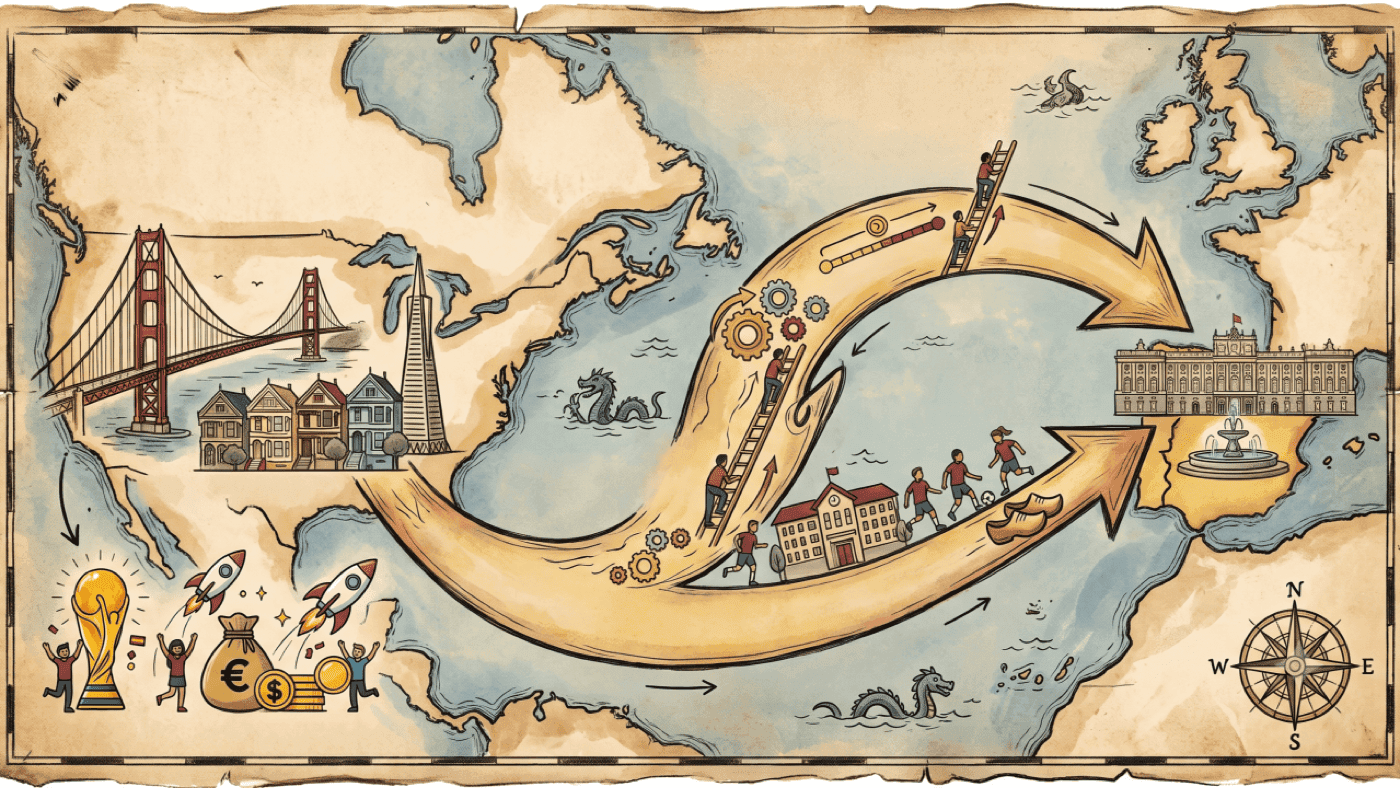
Based on the success of my last post about the World Cup, I decided to do another one about it, this time about the work behind the success, and some thoughts about the entrepreneur ecosystem in Spain based on observations from my last trip there.
Every country that watched Spain win this World Cup will spend the next few years asking how to build a team like that. Very few will copy the method, because the method takes twenty years and most of it is unglamorous.
Spain’s under-17 men won their Euros this year without conceding a goal. The under-19 men have won that tournament 13 times, more than anyone. The women’s under-17, under-19, and senior teams have held world titles at the same time, the first country ever to do it. And every one of those teams, at every age group, plays recognizably the same way: short passing, patient buildup, players comfortable receiving the ball under pressure in tight spaces.
That is an academy decision made decades ago and never abandoned. Cruyff brought Total Football’s DNA to Barcelona’s La Masia in the late 80s. The federation and the clubs kept teaching it at every age group, in the men’s and women’s programs alike, through generations of coaches who came up inside the same system. Twenty of the 26 players on this year’s World Cup roster came through La Masia or the federation’s recent youth title runs. Nobody skipped a step.
You can watch Lamine Yamal for one match and decide you want a player like that. You cannot watch one match and decide to rebuild your country’s youth curriculum, retrain every academy coach in it, and hold your nerve through a decade of mediocre results until the first generation raised inside the system reaches the senior team. Federations want the trophy. The decade where you get worse before you get better is the part that gets skipped.
Silicon Valley gets copied the same way. Governments have poured billions into replicas, and the explanations for why they fail land on the same answer: density. Within a fifty-mile radius you can pitch a VC on Sand Hill Road in the morning, hire an engineer who left Google at noon, and sit across from an acquirer by dinner. And all of this at the radius of UC Berkeley and Stanford. That took seventy years to build and it compounds on itself. Silicon Valley still takes a wildly disproportionate share of venture money for its population, and the gap has widened, not closed.
A worse copy of Silicon Valley is close to the least useful thing a country can build. Spain’s federation didn’t try to out-Brazil Brazil on individual flair or out-Germany Germany on athleticism. It built what it could build, patiently, for two decades, and that turned out to be enough to win everything at once.
I was in Spain for the final. Separate from the football, the numbers coming out of the tech scene this year are worth reading together. THEKER Robotics, in Barcelona, raised a €73 million Series A in June for AI-native industrial robots, led by CRV, with Samsung’s first investment in a Spanish company and LVMH’s first in the Spanish ecosystem. That came less than a year after the largest seed round in Spanish startup history, also theirs. Factorial raised a $150 million Series D from General Catalyst and Atomico. HappyRobot, founded by three Spaniards, just raised $150 million this month at a $1.2 billion valuation, with DHL, Kuehne+Nagel, Repsol, Naturgy and Uber as customers. And OpenAI opens its first Spanish office in Madrid in the second half of this year: ChatGPT’s weekly users in Spain grew more than 40 percent in twelve months, the country is now among its five largest European markets, and Codex use inside Spanish companies has grown elevenfold since January. BBVA, Santander, IE University, IESE and Factorial are already customers.
One detail in that list is the whole problem. HappyRobot was built in San Francisco. Three very talented Spanish founders went through Y Combinator and stayed in the Bay Area, and that is where the $1.2 billion company HQ sits. THEKER stayed in Barcelona. Whether the next ten look like THEKER or like HappyRobot is the actual question for the Spanish ecosystem, and it will be answered by whether there is enough capital and enough customers at home to make staying the obvious choice.
Spain will never be Silicon Valley, and chasing that comparison is the wrong ambition. What Spain has is different: deep technical and engineering talent that has historically left for London, Berlin, or the Bay Area because there wasn’t enough happening at home to keep it. A cost base that builds a serious engineering team for a fraction of what the same team costs in California. Language and business ties that make Latin America a natural extension rather than a foreign market, which matters more every year as engineering talent there gets better and cheaper than Europe’s. And now, frontier labs making a physical bet on the country instead of selling into it remotely.
None of that guarantees anything. Infrastructure alone never won anyone a World Cup either. It has to be built deliberately, sustained past the first disappointing stretch, and given the time Spain’s academies were given, which nobody wants to give anything anymore. But the ingredients are there in a way they weren’t five years ago, and I don’t think enough people building here have clocked it yet.
The team that won the World Cup got built starting around 2005, by people who were fine not seeing the result for a long time. That is the part worth copying.