
Complexity as the status quo
Novanta makes the end-of-arm tooling that multiplies the productivity of an industrial robot. Its catalog spans automotive lines, electronics assembly, aerospace, logistics warehouses, and the humanoid platforms that have become the obsession of the robotics industry. The breadth is the business. It is also the problem: millions of valid configurations, each tied to a specific robot, payload, and job.
Every customer application resolves to a different valid part-number combination of tool changer and modules. Here is what one real answer looks like — one wrong digit and the wrong part ships:
Robot       FANUC R-2000iC/210F
Interface   Direct Boss 80 (verified)
Master      QC-160 9120-160FM-000-000-SM
Tool A      QC-160 9120-160FT-000-000
Tool B      QC-160 9120-160FT-000-000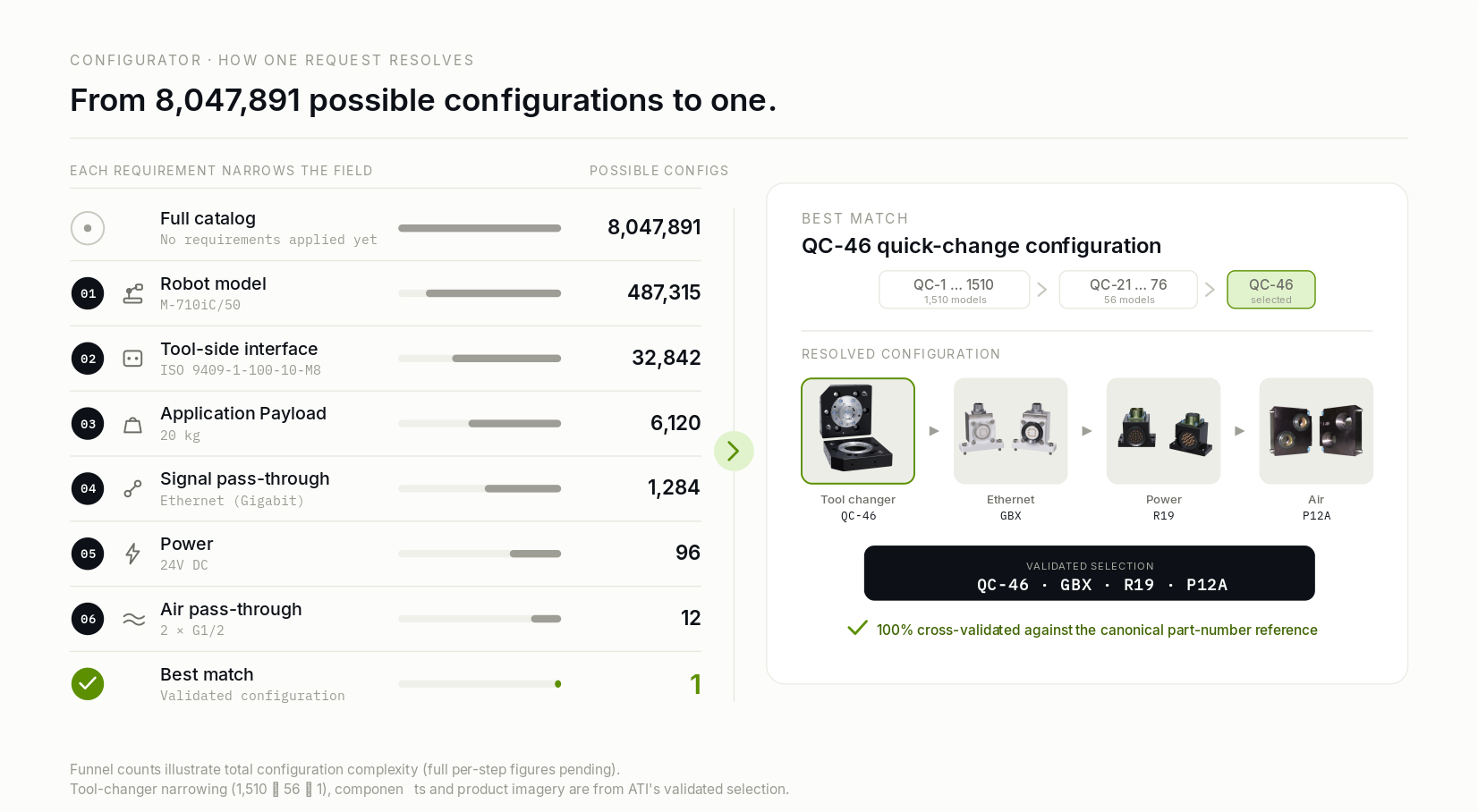
From 8.2 million possible combinations to one best match — the configuration space Quick Consult navigates on every request.
The path from a customer's question to a validated part number ran through a small team of highly skilled application engineers. Decades of pattern recognition lived in their heads: which interface plate ships with which master, what happens above the 300-kilogram payload boundary, and when a generated part number needs a human to sanity-check it. As Novanta pushed for growth across the portfolio, "hire and train more application engineers" was not the answer the business needed.
A bet against the odds
5%
of enterprise generative-AI pilots reach production with measurable impact.
The team at Novanta knew the odds. The MIT NANDA "GenAI Divide" report, published mid-2025, found that 95% of enterprise generative-AI pilots delivered no measurable P&L impact. The same study found that vendor-led, partnership-driven AI projects succeeded in roughly 67% of cases — pure internal builds, at 33%.
Ajaiey Sharma, VP at Novanta and sponsor of this work, had read those numbers. He had executive air cover from Novanta's CEO Matthijs Glastra to take the bet, and a clear instruction to move fast. Novanta partnered with Reshape Automation, the team behind ReshapeX, the AI platform purpose-built for industrial companies — with the knowledge grounding, agent infrastructure, and forward-deployed engineering model that catalog complexity at this scale demands.
How they ran it
What put this project in the top 5% of success stories wasn't a better model or a smarter prompt. Three things did:
- Reshape's knowledge grounding technology gave the agent something true to stand on.
- The Forward Deployed Engineer (FDE) partnership pulled Novanta's institutional knowledge straight from the application engineers who held it.
- A weekly ship cadence, held unbroken for months, kept both teams working at the speed problems surfaced.
Every Monday, a new version of Quick Consult shipped. Novanta's testers exercised the agent in structured weekly sessions, and each session produced traces — every prompt, tool call, and token — captured inside the ReshapeX platform alongside expert feedback. A Reshape Forward Deployed Engineer reviewed each week's traces to isolate failure modes case by case: knowledge gaps, format bugs, and tool-selection errors. A weekly triage call set priorities, and a shared tracker held every open item with named owners on both sides.
When a Novanta engineer noticed the compatibility matrix was wrong about an adapter relation between two parts, the correction was queued that day and shipped in the next release. That is what the cadence bought: the speed to fix things the moment someone caught them. The loop ran unbroken from kickoff through launch. It still runs today.
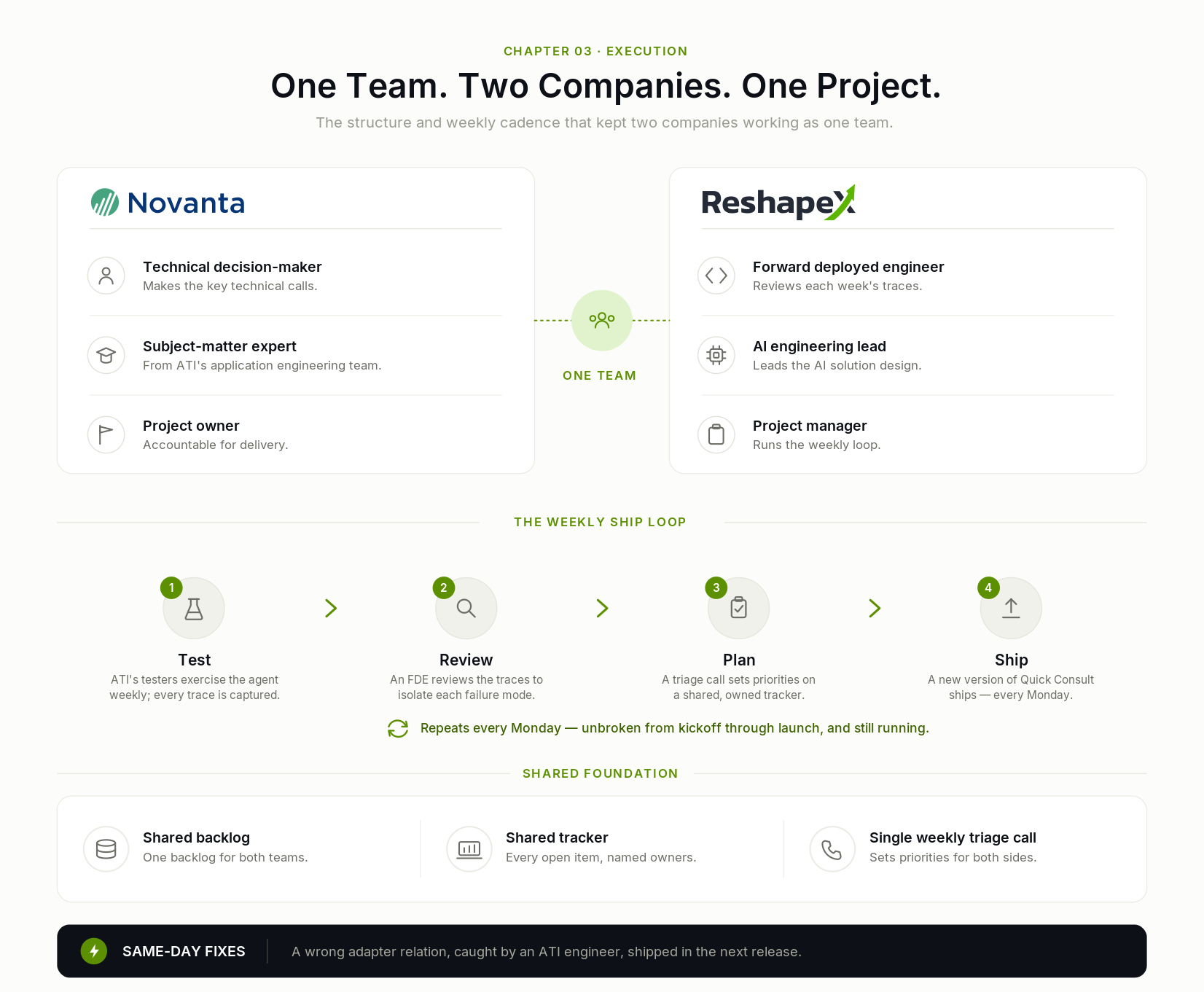
One project, one team. Novanta and Reshape operated as a single unit, with a four-step weekly cadence on a shared foundation.
Both companies staffed the project like it belonged to them. Novanta assigned a technical decision-maker, a subject-matter expert from application engineering, and a project owner accountable for delivery. Reshape assigned a Forward Deployed Engineer, an AI engineering lead, and a project manager running the weekly loop. There was no vendor-and-client dynamic. There was one project, and everyone on it had a role in it.
What they built
Quick Consult is not a chatbot wrapped around a large language model. It is a multi-agent system designed around a specific technical premise: hallucinations are a structural property of how LLMs work. Fine-tuning, better prompts, and bigger models all help at the margin, but none of them eliminate the problem. For an enterprise system that must return validated part numbers, the architecture must handle what the model can't.
Hallucinations aren't a bug. They're how language models work. The question for any serious enterprise deployment isn't whether your model hallucinates. It's what you've built around it. For Quick Consult, the architecture is the product.
Juan Aparicio · CEO & Co-founder, Reshape Automation
The agent runs inside six middleware layers that control what it knows, what tools it can reach for, when it retries, and how much conversation history it carries forward. The architecture is Reshape's general framework for industrial AI: an orchestration layer that routes intent and validates outputs at every node, a tool harness that connects the agent to the customer's tools and ERPs, and a context-engineering layer that manages memory and conversation state.
Quick Consult is model-agnostic by design. Its orchestration layer routes across multiple frontier models, including the Anthropic API (Claude), and cross-validates every output before it leaves the system. That redundancy is part of how the agent holds 100% part-number accuracy against Novanta's canonical reference in production, across 400+ customer sessions and booked revenue since its April 2026 launch.
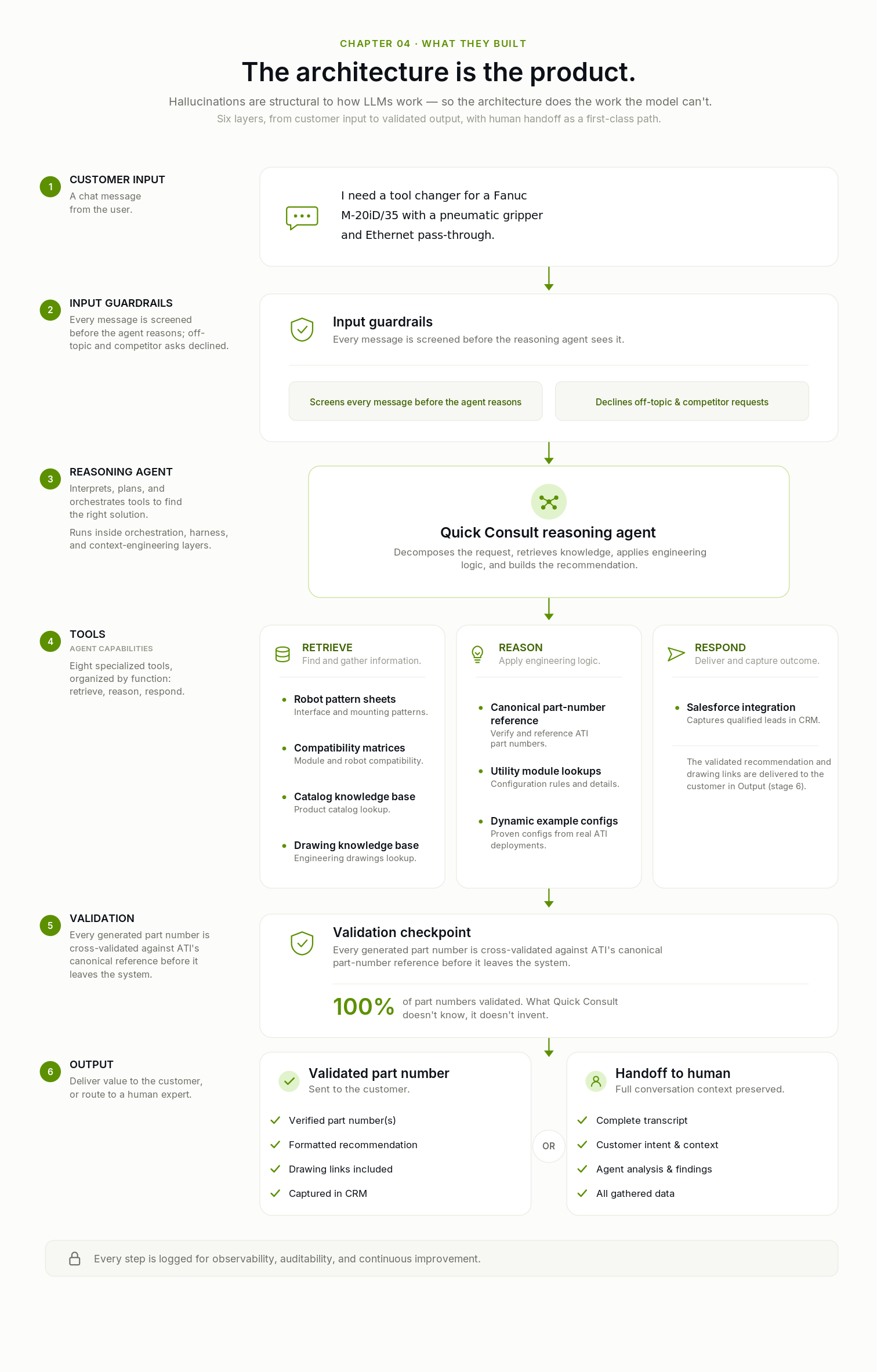
Six layers from customer input through validated output, with human handoff preserved as a first-class path.
Every part number Quick Consult generates is cross-validated against Novanta's canonical part-number reference before it leaves the system. The harder design question is what to do when the agent doesn't know the answer. Quick Consult routes requests it can't validate to a human, preserving the full conversation context. Off-topic asks — such as requests to recommend a competitor's product — are declined. What Quick Consult doesn't know, it doesn't invent.
100%
of part numbers cross-validated against Novanta's canonical reference before they leave the system. What Quick Consult doesn't know, it doesn't invent.
The team evaluated the system against hundreds of random real-world configurations spanning ten distinct behavior categories, from exact match to graceful handoff. The Quick Consult that launched on April 14, 2026 had been stress-tested against the full distribution of how customers actually interact with human application engineers.
What shipped
In the first week, a first sale closed through a European distributor, a hot quote opened in Turkey, and the first booking via the agent was logged. By the end of week two, Quick Consult had served more than 400 customer sessions on Novanta's website, generating tens of thousands of dollars in booked revenue and qualified pipeline — on a trajectory that, sustained, exceeds seven figures in annualized run rate.
What the team has built is more than a working AI agent. It shows how we can apply AI with discipline across our organization to drive meaningful business results. We're focused on scaling this approach, taking what works and extending it across our portfolio to accelerate growth and better serve our customers.
Matthijs Glastra · CEO, Novanta
On a Friday morning in late April, Glastra opened Novanta's site and tested Quick Consult himself, in Dutch. He typed in a real opportunity his team was tracking — the kind of multi-axis application Novanta's engineers would normally spend hours scoping — and the agent returned a sensible configuration. By that afternoon, the test had become a talking point among Novanta executives.
We didn't just expand capacity — we made our expertise available to every customer, instantly. That's how you turn complexity into an advantage and create real, scalable growth.
Ajaiey Sharma · VP, Novanta
The same Test → Review → Plan → Ship cadence that built the agent now improves it.
What's next
What Novanta and Reshape built isn't a one-off. It's an architecture. Every new robot brand, every new tool-changer family, every new module, every new product line slots into the same structure without rebuilding the agent underneath it. The bones extend across Novanta's broader catalog and the other Novanta companies wrestling with similar configuration complexity, or codifying subject-matter experts' knowledge so it can be accessed on demand.
Underneath sits a vertically integrated grounding and harness layer that combines orchestration, observability, a curated knowledge graph paired with a product database and semantic index, and the context engineering that keeps every token in the agent's window earning its place. Below it sits what the team calls the Knowledge Construction System: highly specialized agents ingest product documentation, manuals, ERP systems, websites, and expert input from the application engineers, then handle schema modeling, validation, and FDE review before anything reaches the agents. A continuous synchronization layer keeps the graph up to date as a customer's catalog evolves. Two goals: compress the time to onboard a new brand from months to days, and deliver 99.9% precision at runtime.
That structural lesson generalizes well beyond robotics. Any business with a configurable catalog, an application-engineering queue, and customers who want answers faster than the queue can produce them has the same problem Novanta had. The foundational model didn't solve it. A disciplined team — with active executive sponsorship, working on a stack that doesn't have to be rebuilt for the next agent — did. What Novanta built with Reshape is a template: a reference point for any company trying to turn AI from a pilot into a production system that earns its keep.